Michigan State Police Seize Hundreds of Pounds of Heroin and 174 Firearms in Major Interstate 69 Commercial Vehicle Stop

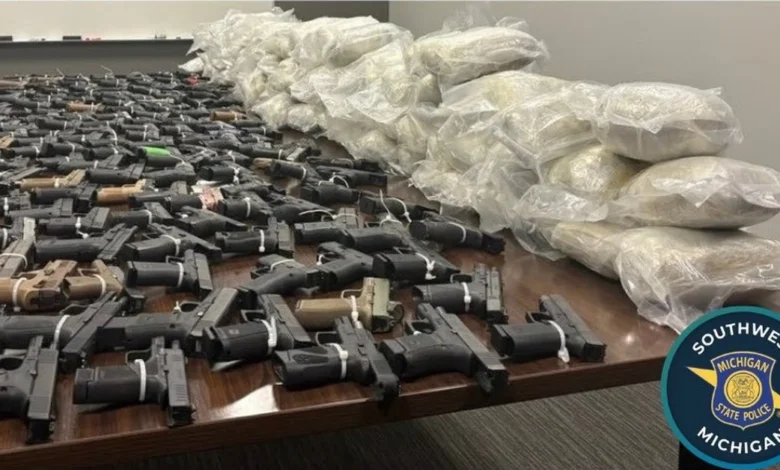
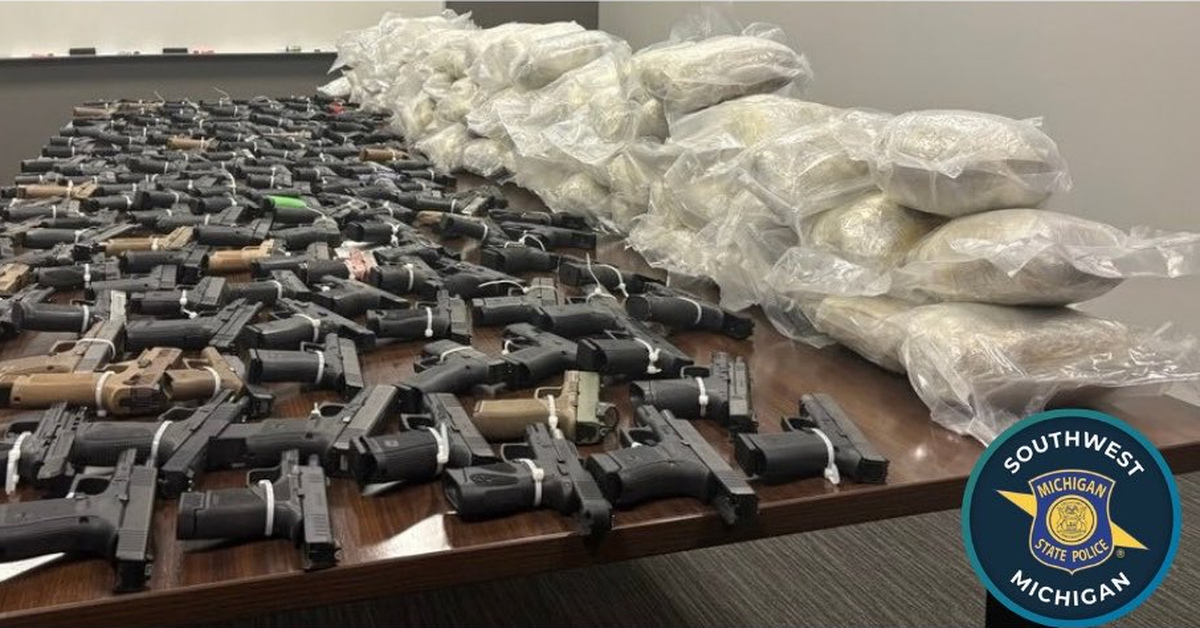
The enforcement of commercial motor vehicle regulations routinely uncovers mechanical infractions, Hours of Service violations, and overweight cargo loads, but a routine inspection on a major Michigan thoroughfare recently took a dark and unexpected turn. On the afternoon of Thursday, September 24, Michigan State Police (MSP) Motor Carrier Officers pulled over a semi-truck traveling on Interstate 69 near Marshall, Michigan. What began as a standard roadside safety check rapidly evolved into a major federal-level narcotics and weapons interdiction operation. Inside the commercial vehicle, authorities uncovered a massive illicit cargo: roughly 368 pounds of suspected heroin packed tightly into dozens of bundles, alongside an astonishing arsenal of 174 handguns bearing obliterated serial numbers.
The discovery underscores the vulnerabilities inherent in the nation’s sprawling interstate freight network, where legitimate commercial logistics corridors are occasionally exploited by transnational criminal organizations to move contraband across state and international lines. As the investigation continues to unfold, federal and state law enforcement agencies are working to trace the origins and intended destinations of both the narcotics and the firearms.
The Chronology of the Interdiction on I-69
The sequence of events began at approximately 2:00 p.m. on September 24. MSP Motor Carrier Officers, tasked with monitoring commercial traffic and ensuring compliance with state and federal motor carrier safety regulations, signaled the semi-truck to pull over on a stretch of Interstate 69 situated in Calhoun County.
Marshall, Michigan, located approximately 45 miles southeast of Grand Rapids, serves as a vital geographic hub in the region’s logistics network. Interstate 69 functions as a critical commercial artery spanning southern Michigan, linking regional distribution centers downward through Indiana and ultimately extending toward the Canadian border. Commercial freight carriers routinely utilize this corridor to move goods between Midwestern manufacturing hubs and international export points.
During the initial phase of the commercial vehicle stop, officers conducted standard protocols, reviewing driver credentials, vehicle documentation, and safety equipment. However, discrepancies or indicators observed during the inspection prompted officers to take a closer look at the cargo hold. Upon conducting a more thorough examination of the commercial trailer, authorities discovered the staggering stash of contraband.
Inside the truck, officers located 92 separate bundles containing approximately 167 kilograms—translating to roughly 368 pounds—of suspected heroin. In addition to the narcotics, the search yielded 174 handguns. A preliminary examination of the firearms revealed that the serial numbers on every single weapon had been deliberately obliterated, a classic indicator that the weapons were intended for illicit markets, untraceable ghost-broker networks, or criminal enterprises where firearms are routinely scrubbed to evade law enforcement recovery efforts.
Arrest and Immediate Aftermath
Following the discovery of the narcotics and the cache of weapons, the male driver of the semi-truck was taken into custody without incident. Michigan State Police subsequently cited the motorist for multiple severe drug- and weapons-related violations.
As of the latest updates from law enforcement, the identity of the driver has been withheld from the public. This decision reflects the sensitive nature of the ongoing investigation, as authorities work to determine whether the motorist operated as an independent actor, a coerced courier, or a willing participant in a broader, organized criminal conspiracy.
The suspect faces severe state and potentially federal charges. Given the sheer volume of the seized heroin and the large number of untraceable firearms, the case is widely expected to transition into federal jurisdictions, where mandatory minimum sentencing guidelines for drug trafficking and firearms violations are significantly more stringent.
Official Stance and Information Controls
In the wake of the high-profile seizure, Michigan State Police have maintained a tightly controlled flow of information. MSP officials provided initial announcements and authorized the use of agency-issued seizure photographs to document the scale of the operation, but investigators have deliberately declined to release further granular details.
Law enforcement spokespersons emphasized that releasing premature information could severely compromise the ongoing investigation. Because multi-jurisdictional narcotics and weapons trafficking rings often span multiple states or cross international borders, investigators must carefully manage intelligence to prevent co-conspirators from destroying evidence, altering communication channels, or fleeing potential sweep operations. Furthermore, the agency cited witness safety concerns as a paramount reason for restricting additional disclosures at this juncture.
Federal agencies, including the Drug Enforcement Administration (DEA) and the Bureau of Alcohol, Tobacco, Firearms and Explosives (ATF), are frequently looped into investigations of this magnitude. While official confirmations of federal task force involvement are pending, the intersection of massive drug shipments and bulk untraceable firearms heavily suggests multi-agency coordination behind the scenes.
Broader Implications for Commercial Motor Vehicle Enforcement
The Marshall, Michigan, incident highlights a critical reality of modern supply chain security: commercial vehicle enforcement (CVEE) is a frontline defense against transnational crime. While the primary mandate of motor carrier officers is to protect the traveling public from unsafe commercial vehicles, fatigued drivers, and overweight rigs, these routine stops frequently act as a net catching high-level criminal contraband.
Drug cartels and domestic criminal syndicates continually search for methods to transport multi-million-dollar shipments of illicit substances and weapons across the country undetected. By blending illicit cargo into the millions of legitimate freight loads moving across the U.S. interstate system every day, traffickers attempt to exploit the sheer volume of commerce that keeps the nation’s economy moving.
Interstate 69 and similar North-South and East-West freight corridors are prime targets for illicit trafficking due to their direct connectivity to major metropolitan areas and international entry points. Incidents like the one in Calhoun County demonstrate that vigilant roadside inspections are not merely regulatory exercises, but vital national security checkpoints capable of disrupting major illicit supply chains.
The Interplay Between Narcotics Trafficking and Illegal Firearms
The convergence of nearly 370 pounds of suspected heroin and 174 serialized, scrubbed handguns in a single commercial trailer points to a well-financed and highly organized distribution network. In the criminal underworld, bulk narcotics and illicit firearms are frequently co-mingled or traded as parallel forms of currency.
Heroin, an opioid derived from the poppy plant, continues to drive profound public health crises across North America. A seizure of 167 kilograms represents a massive financial blow to a trafficking enterprise, carrying an estimated street value worth millions of dollars. Removing this volume from circulation prevents countless doses from reaching vulnerable communities, potentially averting numerous overdoses and associated societal harms.
Simultaneously, the recovery of 174 handguns with obliterated serial numbers presents an alarming public safety hazard. Firearms lacking identifiable serial numbers are virtually impossible for law enforcement to trace back to original point-of-sale vendors, initial purchasers, or previous owners. Such weapons are frequently funneled into street-level gang networks, armed robberies, and violent crime sprees. Intercepting a shipment of this size effectively starves local and regional criminal networks of lethal hardware.
Looking Ahead: Legal Proceedings and Industry Vigilance
As the legal process moves forward, prosecutors are preparing their case against the detained driver. Grand jury indictments or formal arraignments are anticipated as forensic laboratories complete chemical analyses on the seized narcotics and ballistics testing on the recovered handguns.
For the commercial trucking industry, the incident serves as a stark reminder of the importance of vetting, load security, and supply chain integrity. Freight brokers, motor carriers, and shippers face increasing pressure to verify the authenticity of loads, monitor driver backgrounds, and maintain strict chain-of-custody protocols to prevent bad actors from hijacking legitimate logistics networks for nefarious purposes.
Michigan State Police have indicated that additional updates regarding the investigation will be released as judicial proceedings advance and operational security permits. In the interim, the successful interdiction on Interstate 69 stands as a testament to the vigilance of motor carrier officers whose routine roadside stop dismantled a major pipeline of drugs and illicit weapons.